Saturday, 31 December 2022

Lisa’s 43Vision Story

After years of living with the frustrations of bad vision, Lisa found a solution in Custom Lens Replacement from 43Vision!

Ready to escape the readers and enjoy every waking moment with the crisp, clear vision you deserve? It starts with a free exam with one of our doctors. Tap the button or call (405) 883-4343 to schedule now.


source https://www.43vision.com/blog/lisas-43vision-story/

Sunday, 25 December 2022

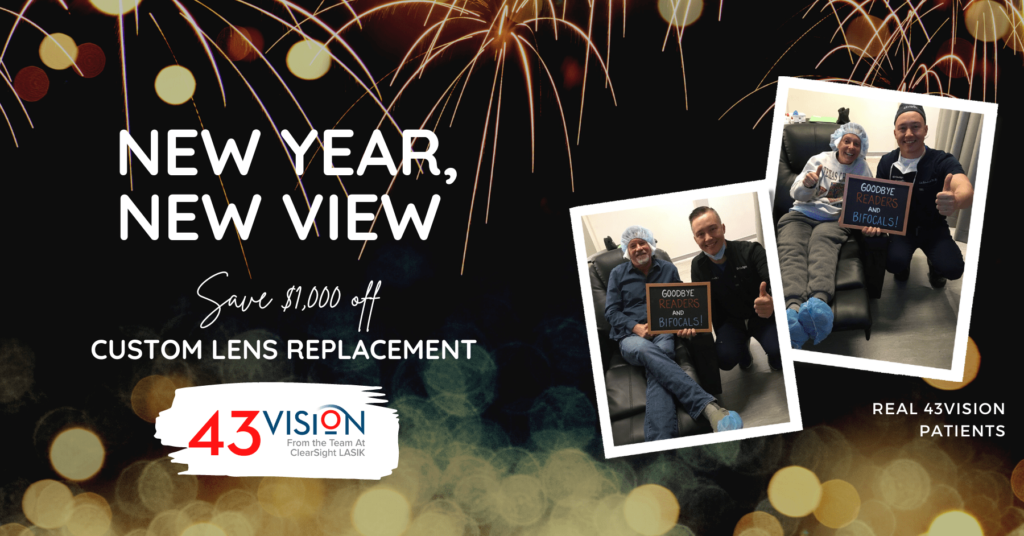
New Year, New VIEW – Save $1,000 to start 2023

If you don’t want to spend another year frustrated with glasses, contacts, readers or bifocals, right now is the time to book your free vision correction consultation at 43Vision.

New years often lead to new goals. Whether you’re focused on health and fitness, growing professionally, or even spending more quality time with the family, it’s always better with crisp, clear vision!

And when you have your consultation at 43Vision in January, you’ll enjoy a special belated holiday gift from our team – a gift certificate for $1,000 off your Custom Lens Replacement procedure.

Book your consult, find out what you qualify for, get all your questions answered. And if you decide life without bad reading vision is the life for you, take $1,000 off your procedure in the month of January.

Tap the button below, or call (405) 883-4343 during business hours, and we’ll be happy to get you scheduled on a day and time that’s convenient for you!


source https://www.43vision.com/blog/new-year-new-view-save-1000-to-start-2023/

Monday, 19 December 2022

Custom Lens Replacement Recovery

The process of replacing the eye’s natural lens with a clear, leading-edge artificial lens implant is known as custom lens replacement and is often referred to as refractive lens exchange (RLE). Because of its versatility and effectiveness, Custom Lens Replacement permanently improves vision and is our most recommended option for custom vision correction at 43Vision.

Custom Lens Replacement procedures reduce refractive error while treating presbyopia, astigmatism, nearsightedness (myopia), and farsightedness (hyperopia) while minimizing or completely eliminating the need for reading glasses and bifocals. Additionally, it eliminates the risk of developing cataracts, preventing the need for cataract surgery in the future.

When considering a custom lens replacement, patients want to know what to expect during the recovery period. In this article, we will discuss the recovery time following a custom lens replacement procedure and answer other frequently asked questions about the healing process. To learn more about custom lens replacement and to schedule your consultation, call 43Vision today!

How long does it take to recover from custom lens replacement?

Lens Replacement patients all heal slightly differently, but most patients should all end up with the same result: improved eyesight and the freedom to do more of what they want in life. After a refractive lens exchange at 43Vision, the initial healing phase typically lasts one week. At this point, the majority of the patient’s daily activities should be resumed.

After having eye surgery, the majority of patients with a considerable correction will immediately notice that their vision without a corrective lens is better than it was before. However, they will still have dilated pupils, which will result in some blurred vision. When the pupil goes back to its original size, eyesight should noticeably improve.

After the procedure, the patient’s visual acuity and visual perception should have improved, and in 24 hours, distance vision should be back to normal. Usually, it takes longer for reading vision and up-close focus to get better with implantable contact lenses, but with a multifocal IOL, reading vision should improve within three to five days. In the initial months of the healing period, you might notice a glare or halos around lights.

A follow-up appointment with your eye surgeon should be scheduled for about a week after the eye surgery. To ensure that the vision correction was effective and that the eye is recovering properly, an examination will be performed. If everything seems to be healing routinely, a final one-month appointment will be scheduled to make sure that vision has stabilized and that the prescription eye-drop medication has worn off. If the second eye is being operated on at a different time, this procedure will proceed according to the same timetable.

If you are tired of having to wear glasses or contact lenses to see clearly or have been told you are not a candidate for laser vision correction, call 43Vision now for more information about Custom Lens Replacement and to schedule your consultation. Clear vision is just a phone call away!

More FAQ’s about Custom Lens Replacement Recovery

How long will I experience blurry vision?

Though most people need 24 to 48 hours, some patients notice an improvement in their vision right away. Sometimes, it can take up to two weeks for vision to stabilize while the eye adjusts to the new intraocular lens implant (IOL).

When can I drive after custom lens replacement?

Much like LASIK eye surgery, after a custom lens replacement, many people can drive again within 24 hours. However, it is strongly advised that you wait to drive following your surgery until you have seen your eye doctor for your follow-up appointment. Your eye surgeon could advise you to postpone driving for a few more days if your vision is still improving.

When can I be left alone after RLE?

You will need someone to drive you home on the day of your custom lens replacement, but once you are home, you should be fine to stay alone as long as you feel up for it.

Can I exercise after custom lens replacement?

Most patients resume their normal exercise routine the day after their custom lens replacement treatment. While walking and other non-strenuous exercise are permitted, patients should avoid activities that cause pressure in the eyes or involve objects flying towards the face (basketball, volleyball, martial arts, etc.) Your surgeon will tell you what activities are acceptable and what to avoid.

How can I reduce the risk of complications after a custom lens replacement?

Attending all of your follow-up appointments and paying close attention to your surgeon’s instructions are the best ways to reduce the risks of any type of refractive surgery, including a custom lens replacement. Using the eye drops recommended by your surgeon to prevent dry eye and keep your recovering eyes lubricated will be one of those guidelines. You’ll be shown which eye drops to use by your doctor. Antibiotic eye drops help with healing, prevent infection, and make the recovery process more comfortable for you.

Will I be in pain after a custom lens replacement?

Custom lens replacement surgery is painless and one of the safest medical procedures out there. The patient will be given a local anesthetic before the procedure to ensure that they won’t feel any pain. Patients commonly experience some brief discomfort as the anesthetic wears off.

It is common for patients to experience mild discomfort or itching around the eye in the days after having artificial lenses implanted, but this usually goes away quickly. In most cases, over-the-counter analgesics are more than adequate to treat any discomfort the patient may be feeling.

The 43Vision Difference

The best way to determine if a custom lens replacement or laser eye surgery is right for you is to schedule your free exam at 43Vision and get an official recommendation from our eye doctors. 43Vision is the first vision correction center dedicated to helping people over the age of 43 who want to reduce or eliminate their need for reading glasses or bifocals.

Our state-of-the-art vision correction clinic uses the most cutting-edge technology available to combat presbyopia’s effects and prevent patients from having to deal with cataracts in the future. The most common comment we get from patients is that they wish they had gotten their vision corrected sooner. So what are you waiting for? Call 43Vision today and start your journey to clear vision and eliminate glasses or contacts for good.


source https://www.43vision.com/blog/custom-lens-replacement-recovery/

Monday, 28 November 2022

Refractive Lens Exchange vs. Cataract Surgery

It is estimated that over half of all Americans will need cataract surgery at some point in their lifetime. Because it is so common for adults to develop cataracts later in life, most people are familiar with cataract surgery.

While a refractive lens exchange and cataract surgery are similar procedures, they do have some differences. In this article, we will talk about what cataract surgery and refractive lens exchange are, how they are similar, and what makes them unique.

43Vision is the first vision correction center specifically designed for people aged 43 and older who desire to lessen or do without the need for reading glasses or bifocals. Our center uses the most cutting-edge technology available to treat presbyopia’s effects and prevent our patients from having to deal with cataracts in the future.

To learn more about the custom vision correction procedures we offer at 43Vision, call our office today to schedule your comprehensive eye examination and start your journey to visual freedom.

What are cataracts, and how are they treated?

The clouding of the eye’s lens is known as a cataract. Your lens becomes foggy as you age because the proteins in your lens start to break down. Because cataracts on the human eye typically develop very slowly and may not initially impair vision, you might not even be aware that you have one. While cataracts are rarely dangerous, over time, they are likely to impair eyesight and cause blurred vision that cannot be improved with a corrective lens.

Over 90% of people by the age of 65 have cataracts, and 50% of those between the ages of 75 and 85 have some visual impairment as a result. Overusing your eyes does not produce cataracts, and they do not spread from one eye to the other.

Since the human lens is clear, light can readily pass through it. It is 65 percent water and has no blood supply. Although the lens continues to produce new cells throughout our lifetimes, a number of factors interact as we age to cause certain regions of the lens to become hazy, hard, and dense. The cloudy lens is then unable to provide a clear image to the retina for processing before sending it to the brain via the optic nerve, causing blurry vision.

Cataracts may develop with age, be congenital, the result of trauma to the eye, or be linked to another factor, such as a medication or disease. Once cataracts have developed, they can only be treated surgically by being removed and replaced with an artificial lens. Your eye doctor can implant a variety of lens types and powers during surgery, including a multifocal intraocular lens or lenses that treat astigmatism. Your visual acuity will improve, and your need to wear glasses will probably be lessened after surgery but not eliminated.

You and your surgeon will discuss the best type of lens implant and power for you to achieve the visual perception you are hoping for. A cataract cannot be treated with medication. Surgery is often done under local anesthetic as an outpatient procedure. You and your ophthalmologist will talk about the best time to get the cataract removed after it has gotten bad enough to affect your quality of life. Cataract surgery is the most common surgery performed worldwide.

What is refractive lens exchange?

Patients over 40 who are dissatisfied with their reading glasses and vision deterioration may benefit from the vision correction procedure known as RLE (Refractive Lens Exchange), or sometimes as CLR (custom lens replacement). RLE, also known as the Lifestyle Lens, enables patients to resume many of their favorite activities.

The natural lens of the eye is removed during the RLE procedure, and it is replaced with an artificial Intraocular Lens (IOL) to focus and correct your vision. Reducing reliance on glasses is the main goal of an RLE. Before the procedure, your eye will be numbed using anesthetic eye drops. To access the lens, your eye surgeon makes a tiny, less than 3mm-long opening in the eye. The process results in the formation of a capsulorhexis. The lens of the eye is then disassembled and removed using an ultrasound probe. The name of this process is phacoemulsification. A new intraocular lens (IOL) is placed in the eye after these natural lens fragments have been removed. The IOLs are foldable and flexible to fit through the narrow hole. They unfold and assume their position once within the eye. The treatment takes less than 30 minutes, and the IOLs are permanent.

There are a variety of high-end IOLs available to fit your needs and lifestyle. To choose the IOL that is best for you, highly precise measurements are done with cutting-edge equipment. You can use the accommodating IOL to improve your ability to see up close or far away, or you can choose a multifocal IOL to address both viewing distances at once. The majority of RLE patients may no longer need to wear contact lenses or glasses at all.

Are cataract surgery and refractive lens exchange (CLR) the same thing?

Refractive lens exchange, or custom lens replacement, and cataract surgery are essentially the same surgical procedure that involves the implant of a phakic intraocular lens (phakic IOLs), but there are some important differences. The major distinction between the two is that in RLE, the eye’s natural lens is not cloudy, and the main goal of the procedure is to lessen a patient’s need for glasses. RLE is not used to treat cataracts but can, in fact, prevent their development later in life, as an artificial lens cannot get cataracts.

Many patients choose to have RLE after developing presbyopia that cannot be successfully treated with laser vision correction. Presbyopia is an age-related condition where the natural crystalline lens inside the eye loses its ability to focus on close objects. While both RLE and cataract surgery involve replacing the eye’s natural lens with artificial intraocular lenses, the main difference is the reason for having the procedure.

Modern cataract surgery has developed into a refractive surgery with advancements in ophthalmology. The majority of cataract patients want a higher quality of life and the clearest vision possible in addition to the removal of the cataract.

The main distinction between RLE and cataract surgery is that cataract patients are seeking treatment for a visual deficiency that an eyeglass prescription cannot help and, generally speaking, are delighted with any level of improved vision. Patients with RLE typically have good vision with glasses or contact lenses and are striving for clear vision without the need for them.

What are the benefits of lens replacement surgery?

RLE is a technique that is both safe and effective for patients over the age of 40. One of the benefits of RLE, also called custom lens replacement) as opposed to LASIK (laser-assisted in situ keratomileusis), is that it is a more long-lasting treatment for presbyopia and can address any refractive errors you might have, including astigmatism, hyperopia (far-sightedness), and myopia (nearsightedness). It is also a great vision correction alternative for those who do not qualify for laser eye surgery because their cornea is too thin.

Additionally, you won’t need another procedure to treat cataracts in the future. You can achieve independence from glasses or contacts thanks to the implanted lenses, which are permanent and last the rest of your life. Improved focus, better vision, cataract prevention, lessened glare and halos, and an easier time differentiating colors (contrast sensitivity) are among the advantages of RLE.

Clearer vision and improved refraction are the most obvious benefit of cataract eye surgery. However, a patient’s quality of life is also greatly improved with cataract surgery. In addition, cataract surgery is a quick procedure with a simple recovery period that results in improved vision while protecting eye health.

43Vision specializes in Custom Lens Replacement, and it is our most recommended vision correction option because it can address so many different vision issues. To learn more and find out if you are a candidate for RLE, schedule your exam with our highly trained and experienced team at 43Vision. Call our 43Vision office at 405-883-4343 or schedule an exam on our website now.


source https://www.43vision.com/blog/refractive-lens-exchange-vs-cataract-surgery/

Thursday, 24 November 2022

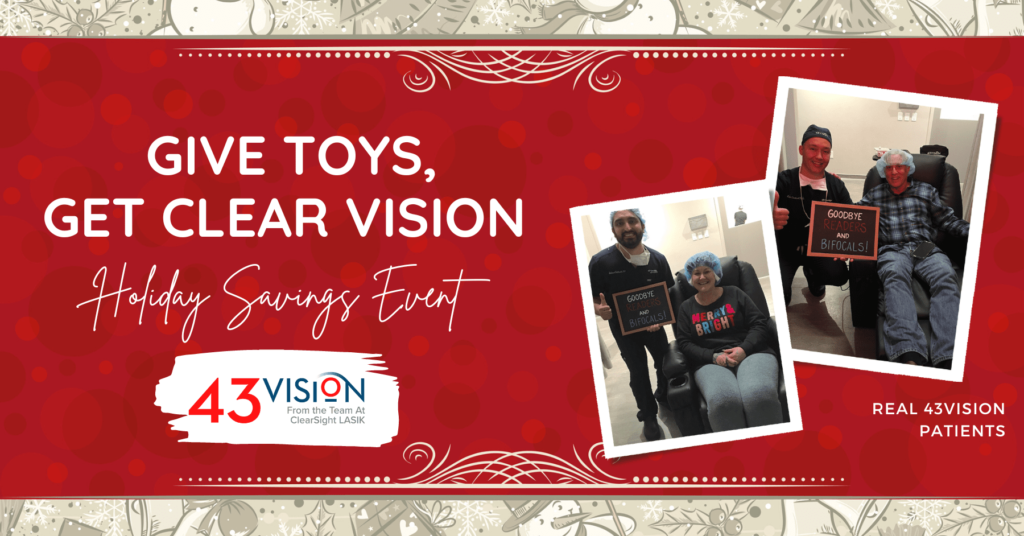
Give Toys, Get Clear Vision (How to Get Our Best Pricing of the Year)

It’s supposed to be the MOST wonderful time of the year…

But for some in our community, the holiday season leaves a lot to be desired. Especially those who don’t have the resources to put gifts under the tree.

That’s why we’re partnering with our patients for our annual ClearSight & 43Vision Toy Drive! It works like this:

  1. Bring a new, unwrapped toy to your consultation appointment at 43Vision.

  2. We give you a $1250 Gift Certificate to use toward your procedure. (our biggest savings of the year!)

Pretty simple, right?!

You’ve thought about getting your bad vision fixed, and now is the time. Save big, support our community, and enjoy the holidays with the crisp, clear vision you know you deserve.

Tap here to book online, or give us a call – (405) 883-4343.


(Cannot be combined with any other offers)


source https://www.43vision.com/blog/give-toys-get-clear-vision-how-to-get-our-best-pricing-of-the-year/

Monday, 21 November 2022

Custom Lens Replacement vs. Refractive Lens Exchange: Is There a Difference

For visual changes brought on by aging in your eye’s natural lens, Refractive Lens Exchange (RLE), sometimes referred to as Custom Lens Replacement (CLR), offers a precise and long-lasting solution. What is the difference between the two procedures? Nothing but the names. RLE is like turning back the hands of time, according to those who have had it done. It gives you a more youthful field of vision while preventing cataracts in the future.

People who want to repair and enhance their vision without the use of contacts or glasses and avoid the necessity for cataract surgery are becoming more and more interested in Refractive Lens Exchange. 43Vision is committed to transforming lives by providing people with the gift of better vision. We want to improve your ability to perceive the world clearly. To schedule a consultation and find out if you qualify for any of our life-changing procedures, call our office today.

Refractive Lens Exchange: What Is It?

Both the terms refractive lens exchange and custom lens replacement apply to the same procedure. The natural lens of the eye is replaced with an intraocular lens (IOL) during a Custom Lens Replacement procedure, also known as RLE, to restore vision and eliminate refractive errors. A defect in the shape of the eye that prevents light from correctly focusing on the retina is referred to as a refractive error. This vision loss may be brought on by cataracts, astigmatism, presbyopia, nearsightedness (myopia), or farsightedness (hyperopia). Not only is vision significantly better after intraocular lens implantation with RLE, but the benefits are also favorable and long-lasting.

RLE technology, also known as CLR, is currently the most effective and safe it has ever been and is being used successfully all over the world. Patients who have had vision correction thanks to RLE experience a new level of visual freedom. Many people decide to have RLE performed before cataracts have an opportunity to develop, and with an accommodating, multifocal IOL, toric lens, or array multifocal lens, your improvements in visual acuity will be dramatic. You don’t need to let bad vision keep you from leading the life you’ve always wanted. 43Vision is here to provide you with the freedom to see life more clearly while also assisting you in improving the quality of your vision.

FAQ’s about Custom Lens Replacement vs. Refractive Lens Exchange

Following a Refractive Lens Exchange, will I require glasses?

Several factors will influence whether you decide to wear glasses full-time, part-time (like reading glasses), or not at all. These factors include general eye health, the degree of astigmatism, your current eyeglass prescription, the type of intraocular lens IOL you choose (multifocal intraocular lens, accommodating intraocular lenses, toric lenses, monofocal IOL, etc), and your visual requirements.

Regardless of the type of artificial intraocular lens implanted, you might occasionally need to wear some type of corrective lens. But with the correct IOLs, you can greatly enhance your vision and lessen or even do away with the need for glasses. You can select the IOL that most closely suits your visual needs and way of life with the aid of a skilled eye surgeon.

What distinguishes a Custom Lens Replacement from a Refractive Lens Exchange?

Custom Lens Replacement (CLR) and Refractive Lens Exchange (RLE) are two alternative names for the same treatment. The procedures are also sometimes even referred to as a clear lens exchange or clear lens extraction. No matter which name you decide to call it, the process of removing the natural lens that the eye uses to refract light and replacing it with an artificial lens to improve visual perception is the same for these procedures.

How long does it take for a Refractive Lens Exchange procedure?

Patients should plan on spending two to three hours in the office on the day of their RLE procedure. We will do some of the same tests carried out during your comprehensive consultation before beginning the procedure in order to give your eye surgeon the most accurate evaluation of your vision that is possible.

On the day of surgery, we’ll spend most of our time getting you ready and responding to any last-minute questions you might have. The actual procedure only lasts 15 to 30 minutes. The visual freedom and independence our 43Vision patients experience after custom lens replacement are remarkable.

Is there a treatment for presbyopia using refractive lens exchange?

In America, more than 100 million individuals suffer from presbyopia. Presbyopia is one of the most common age-related eye conditions that can occur with or without nearsightedness, farsightedness, or astigmatism. It is challenging to read, complete paperwork, or operate on a computer screen when you have presbyopia. In order to combat presbyopia, many people turn to reading glasses, but they soon get weary of the constant battle to see details up close.

Refractive Lens Exchange can effectively treat presbyopia. Using a multifocal lens, a custom lens implant can correct both near and far vision. Presbyopia is best managed by replacing both lenses, through custom lens replacement, in one or both eyes. If you’re unsure about whether RLE is the ideal operation for you, our highly trained experts at 43Vision would be pleased to assist you. To arrange your consultation and find out if you’d be an eligible candidate for RLE, call our office today.

Can a Refractive Lens Exchange “wear off?”

A Refractive Lens Exchange (custom lens replacement) uses intraocular lenses that are designed to last a lifetime. An intraocular lens never needs to be replaced and does not degrade over time like a traditional contact lens. By carefully following their surgeon’s post-procedure recommendations, patients can help protect their IOLs.

Does Dysfunctional Lens Syndrome benefit from Refractive Lens Exchange?

Dysfunctional Lens Syndrome (DLS) is the gradual loss of eyesight caused by the natural lens in your eye. Your natural lens is translucent and flexible when you are born. Light can pass through your eye because of its transparency without causing glare, light dispersion, or blurred vision. Because of its versatility, the lens may change its form and focus, letting you see objects from a distance as well as up close. Your lens gradually becomes cloudier and less flexible as you age.

Refractive Lens Exchange can treat DLS. You can see clearly since the new intraocular lens is translucent and allows light to pass through. Modern intraocular lens implants may be accommodating, multifocal, or toric (correcting astigmatism) in order to assist with focusing. Many patients with accommodative intraocular lenses or multifocal implants for near- and far-sightedness do not have to wear glasses. Since it can heal many of the problems of DLS, custom lens replacement is one of the wonders of modern medicine.

How painful is Refractive Lens Exchange (RLE) surgery?

RLE is a safe and painless surgical procedure. Prior to the treatment, the patient will receive a local anesthetic eye drop to ensure they won’t experience any pain. As the anesthesia wears off, patients frequently experience brief, mild discomfort. In the days following a lens replacement treatment, it is common for patients to experience some minor discomfort or itching around the eye, but this normally goes away in a few days. The majority of the time, over-the-counter medications are more than sufficient to alleviate any discomfort the patient may experience.

Are you awake during the Custom Lens Replacement?

During a Custom Lens Replacement, you will be awake, but you will recieve oral medication to help you relax, and your eye surgeon will oversee every step of the process. The 43Vision team will make sure you are at ease and comfortable before, during, and after your procedure while you are in our office.

After a Refractive Lens Exchange, when can I resume exercise?

You can resume your regular daily activities on the day after surgery. We advise that you begin light exercise three days after the procedure and resume vigorous exercise one week later to give your eyes time to acclimate. You can go back to swimming a week following treatment, but we recommend wearing goggles to protect your eyes from the chlorine’s stinging effects. After four weeks, you can swim without any restrictions. By following the post-procedure instructions, eyes can heal properly, thus optimizing refractive lens exchange results.

Is Cataract Surgery the same as Refractive Lens Exchange?

RLE and contemporary cataract surgery are very similar procedures. In both procedures, the natural lens of the eye is replaced with a synthetic lens that is inserted through a tiny incision.

A custom lens refractive procedure is performed to reduce the need for glasses or contact lenses. Contrarily, standard cataract surgery is typically done to address any blurring or light diffraction brought on by a hazy natural lens, or cataract.

Does insurance cover Custom Lens Replacement?

Since a refractive lens exchange is seen as an elective treatment, most medical insurance plans do not cover the cost of the procedure. For a cataract surgery most medical insurance plans typically don’t cover premium lens technology that is often used in refractive lens exchange, most often the lenses that are covered by insurance are not able to fix astigmatism or presbyopia.

Is Refractive Lens Exchange the same as LASIK?

The cornea of the patient is not cut or reshaped during an RLE procedure. The patient’s natural crystalline lens, which is located behind the colored portion of the eye known as the iris, is removed and changed out with a biocompatible artificial lens rather than having tissue from the cornea removed.

Let 43Vision Help You See Life Clearly

At 43Vision, we think it’s easier to fully appreciate each moment as it unfolds when you don’t wear glasses or contacts. Our eye doctors would love to meet you to see if Custom Lens Replacement can be the correct answer to help you live without the restrictions of glasses or contacts so that you can take advantage of everything life has to offer. Refractive Lens Exchange is frequently advised for patients who are not candidates for laser vision correction or other types of refractive surgery. To find out more information and see if CLR is the best option for you, call our office to schedule your comprehensive eye exam.


source https://www.43vision.com/blog/custom-lens-replacement-vs-refractive-lens-exchange-is-there-a-difference/

How to Get Rid of Reading Glasses

Wearing corrective lenses of any type, be it contact lenses or glasses, can become unpleasant over time. At first, wearing reading glasses may seem fun and even fashionable for a lot of people. But once the newness wears off, they become more of a burden and one more thing to keep up with, clean, and replace. Many patients ask us if there is a way to correct their vision so they no longer need to wear reading glasses. At 43Vision, we are here to offer that hope to our patients. A life with clear reading vision can be possible without glasses or contacts. There are many treatment options available to correct vision, and the expert team at 43Vision would love to help you say goodbye to your glasses! Call our office today for additional information or to schedule an appointment and put reading vision problems in your past.

Can you get rid of reading glasses?

Small print becomes increasingly challenging to read as we age, and blurry vision can become quite bothersome. You might come to believe after a while that you have no choice but to get a couple of sets of reading glasses and be stuck with them for the rest of your life. For those who have never worn glasses before, this adjustment can be very stressful.

Until the natural lens in their eye develops a cataract and they need cataract surgery to correct their vision, many people struggle along with their readers or keep buying new pairs of glasses or bifocals. However, if you require readers at age 45 but don’t develop cataracts severe enough for surgery until you are 65 or older, you will have to use readers for at least 20 years!

43Vision is proud to offer patients a procedure called Custom Lens Replacement, which is also known as Refractive Lens Exchange (RLE). It is similar to cataract surgery but is performed before cataracts have developed and treats nearsightedness (myopia), farsightedness (hyperopia), and astigmatism. In a custom lens replacement procedure, a customized artificial lens is used to replace the eye’s natural lens. This flexible artificial lens enables you to focus on both close-up and distant objects and enhances visual perception.

Within a few days of the procedure, vision returns to normal as the eye heals. Over the coming weeks and months, the eyes will adjust and become even more focused as vision sharpens. The best news is the artificial lens won’t develop a cataract after custom lens replacement, so you won’t have to worry about returning for another procedure in the future.

Glasses-free after 43 is always our goal at 43Vision! With Custom Lens Replacement, the majority of our patients can anticipate being able to go about their typical daily activities without any glasses. The same can be expected for blended LASIK patients; however, as your natural lens continues to harden and your requirement for readers becomes more apparent, you should consider custom lens replacement. Yes, you really can get rid of reading glasses!

Does everyone eventually need reading glasses?

Whether you use prescription glasses now or not, reading glasses will most likely ultimately be necessary for you as your eye’s ability to focus diminishes. Even if you never had to wear glasses while growing up, you will unavoidably require a set of reading glasses or multifocal contact lenses by the time you are in your early to mid-forties, unless you are naturally near sighted, in which case your distance vision would be blurry.

The lens inside our eyes must bend in order for us to view objects up close, such as on a computer screen, in a book, a sewing needle, or text messages on a smartphone screen. The more it can bend, the clearer the surrounding objects become to us. The lens inside of our eyes stiffens up as we get older and more mature. It can no longer flex as much as it once could, making close things appear blurrier.

When our eyes are young, our lens is flexible and malleable like an inflated balloon, enabling sharp close vision. As we grow older, the lens in our eyes begins to stiffen and become less flexible, leading to fuzzy near vision. The medical term for this natural occurrence is presbyopia. Around the age of 40, it starts to become more noticeable, and it stays with you the rest of your life.

It could be annoying at this point since things that were once clear without reading glasses or contact lenses need some more assistance. Fortunately, there are lots of options to help you get used to this completely normal process! These include:

•Glasses for reading

•Bifocal Lenses

•Progressive lenses

•Multifocal Contact Lenses

•Monovision Contact Lenses

•FDA Approved Eye Drops for Presbyopia

•Multifocal Intra-ocular Lenses

•Corneal Inlays

Researchers are working to get Food and Drug Administration (FDA) approval for multifocal LASIK treatments like PresbyLASIk, Supracor, and Intracor, in addition to all of these other alternatives.

At 43Vision, we specialize in using Custom Lens Replacement and Blended LASIK (laser blended vision correction) to help our presbyopic patients. Call our office today to learn more and find out how you can get rid of reading glasses for good.

Does LASIK eliminate reading glasses?

For those seeking treatment for trouble with nearsightedness or other common refractive errors of the eye, LASIK laser vision correction may be an excellent alternative. However, treating presbyopia is not its intended use. LASIK reshapes the cornea to improve vision, but presbyopia affects near vision because of changes to the eye’s lens. You might still require reading glasses in your 40s or 50s, even if LASIK surgery in your 20s freed you from glasses and contacts.

To correct presbyopia, some eye specialists use a procedure called blended LASIK. A blended technique is used to correct near vision for one eye and distance vision for the other eye. Blended vision is not for everyone because it depends on the brain’s capacity for adaptation, but approximately 75% of patients are able to tolerate it. Many people over 40 also experience dry eye issues, and LASIK has been known to exacerbate dry eye symptoms. There is little data on how effective this off-label LASIK use is for individuals with presbyopia, and it is not FDA authorized as a treatment for the condition.

Does LASIK speed up the need for reading glasses?

Presbyopia is the age-related decline in near vision that results in adults over 40 beginning to experience blurred vision when reading things up close. Presbyopia is not brought on by LASIK, but there are ways to use the procedure to treat it. Presbyopia is a natural part of becoming older, whether or not you’ve had LASIK. It happens to everyone at some point.

The natural lens of the eye, which is found inside the eye behind the pupil, stiffens with age. The lens’s function is to bulge or flex to provide clear close-up vision before relaxing to provide clear distance vision. A youthful person is always looking up close and then back out to distance, flexing and then relaxing their lens. In those under the age of 40 with healthy eyes, this flexing and relaxing is an instinctive and natural action. But after the age of 40, the lens gets progressively stiffer with time until it reaches its maximum stiffness at the age of 60. For this reason, it is normal for healthy eyes to begin noticing a gradual loss of close vision beyond the age of 40, as well as a gradual increase in the requirement for reading glasses.

This process does not result from LASIK. In actuality, LASIK surgery is carried out on the cornea—the eye’s outer surface and does not involve touching the lens. If you’d like to know more about freedom from glasses, call 43Vision to schedule an appointment and let our team of doctors help you determine which procedure is right for you.

Can I wear contacts instead of reading glasses?

Are contacts available for reading? Yes! Instead of carrying reading glasses with them wherever they go and keeping a pair in the car, desk, purse, or pocket, many people choose to wear contact lenses to solve this issue. Presbyopia can be corrected in a variety of ways, including contact lenses that feature bifocals—a form of multifocal lens—which are intended for those who struggle to focus on close-up objects due to presbyopia.

Multifocal contacts have lens powers that complement vision at close, moderate, and far distances. They are contact lenses with several prescription strengths to treat for conditions like presbyopia. You can wear multifocal lenses even if you only require reading glasses because they have numerous power prescriptions, and the distance prescription can range from 0 to gradually rising power.

While you can wear contact lenses or even just one contact lens to help with reading vision, most people find this to be a hassle and look to 43Vision for a more permanent solution for their vision problems. In addition, the quality of the optics of a multifocal lens implants is higher than the quality of the optic of a contact lens. Call our office to find out how Custom Lens Replacement can give you the freedom from contact lenses and glasses today.

Get Rid of Glasses with 43Vision

Patients who are normally over 40 with refractive errors (nearsightedness or far-sightedness) and presbyopia (aging eyes) make good candidates for Custom Lens Replacement. If you are ready to say goodbye to eyeglasses or contacts that you’ve needed for distant vision correction as well as reading correction, haven’t yet developed cataracts, and maybe been told that LASIK wasn’t the greatest option to achieve your visual goals, then Custom Lens Replacement may be right for you.

Visit our staff at 43Vision if you are tired of dealing with readers and want clear vision for life. We might have the ideal approach for you to have the eyesight you’ve dreamed about!


source https://www.43vision.com/blog/how-to-get-rid-of-reading-glasses/